Small dents become lost revenue when a workshop outsources them, pushes them into repaint work unnecessarily, or cannot explain which damage is suitable for paintless repair.
Training guide
Choose PDR training based on the repair work you want to keep in-house.
Review when paintless dent repair training makes sense, what participants need to learn, what damage types are realistic, and what M&H Group should confirm before booking.
Buyer guide
Use this guide before choosing equipment or requesting a quote.
This guide helps a workshop understand the problem, the right user profile, the business reason, what to compare, and what M&H Group should confirm.
What this guide covers
Read the decision logic before choosing a product option.
Best for bodyshops, dealerships, technicians, entrepreneurs, insurers, and repair businesses that want practical hands-on dent assessment, tool control, light reading, and repair capability.
Compare current dent volume, technician background, practice time, repair limits, customer expectation, training seat availability, starter tools, and how PDR will be offered after the course.
Ask M&H Group about course dates, deposit process, required skill level, group size, practice expectations, starter equipment, and whether PDR should be linked with SMART repair or dealer aftersales services.
Problem solved: Small dents become lost revenue when a workshop outsources them, pushes them into repaint work unnecessarily, or cannot explain which damage is suitable for paintless repair.
Who this fits: Best for bodyshops, dealerships, technicians, entrepreneurs, insurers, and repair businesses that want practical hands-on dent assessment, tool control, light reading, and repair capability.
Why it matters: PDR can support faster turnaround and OEM paint retention where the damage is suitable, but it only becomes useful when training, practice, service menu, and realistic damage limits are understood.
What to compare: Compare current dent volume, technician background, practice time, repair limits, customer expectation, training seat availability, starter tools, and how PDR will be offered after the course.
What to ask M&H Group
Ask M&H Group about course dates, deposit process, required skill level, group size, practice expectations, starter equipment, and whether PDR should be linked with SMART repair or dealer aftersales services.
PDR trainingRelated search topics
paintless dent repair trainingRelated search topics
automotive repair classes ThailandRelated search topics
PDR training BangkokRelated search topics
PDR equipmentRelated search topics
before requesting a quote
Confirm the practical details before investing.
This guide does not replace an M&H Group review. It helps the first quote discussion start from the right operating facts.
Weekly job volume, most common work types, and which jobs still leave the workshop.
Bay layout, air, power, extraction, ventilation, and physical constraints.
Operator skill level, training requirement, and handover process after installation.
Consumables, spare parts, machine care, and the person responsible for the process after installation.
Related equipment
Open the related product and planning options.
Book Basic PDR Level 1 in BangkokView all workshop training optionsPDR equipment and toolsCheck if PDR fits your workshop pathAsk about PDR seats and equipment
Is PDR suitable for every dent?
No. PDR depends on dent size, location, paint condition, panel access, and technician skill.
Who should attend the PDR course?
Workshop owners, technicians, entrepreneurs, dealerships, and repair teams that want practical hands-on dent repair capability.
Should I buy PDR equipment before training?
M&H Group can help review training path and starter equipment so the purchase matches real use.
Next step
Upgrade the workshop conversation from equipment purchase to measurable production capability.
M&H Group Academy
Study PDR foundations at your own pace.
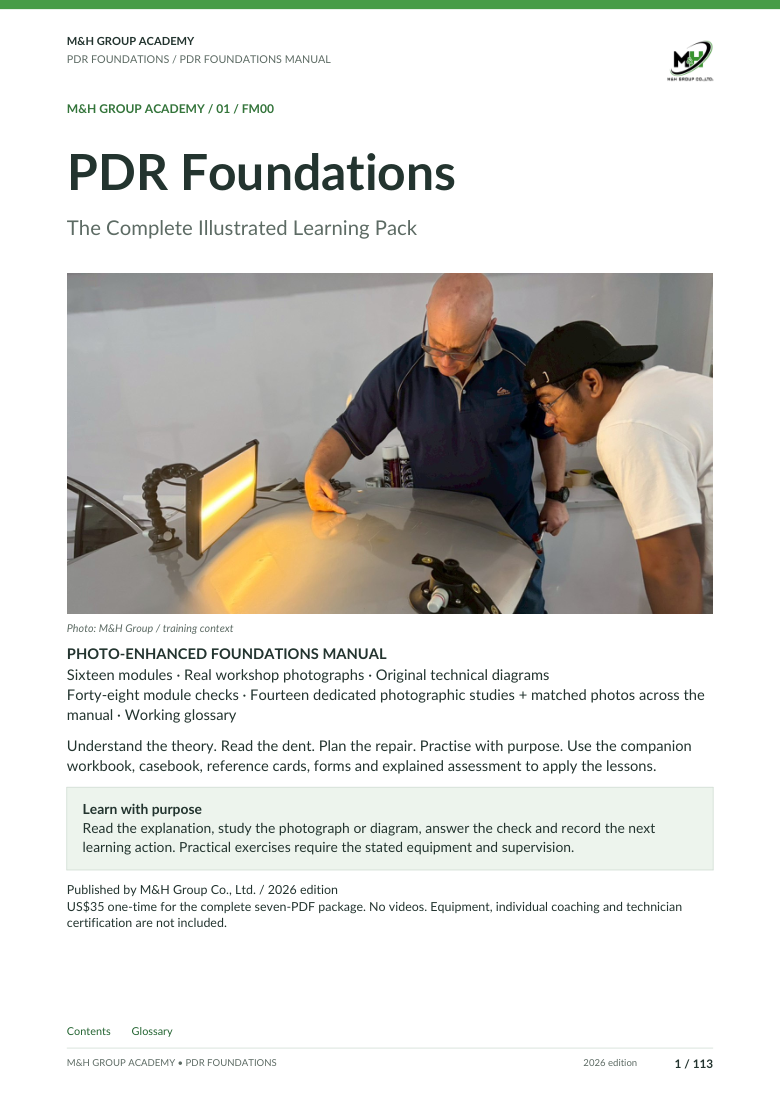
Explore seven English PDFs with 235 pages of PDR foundations, practice activities and illustrated case studies. Read the sample, then ask M&H to confirm availability and purchase arrangements.
Full files are sent privately by staff after payment is confirmed, never downloaded from this website. Hands-on training is booked separately.